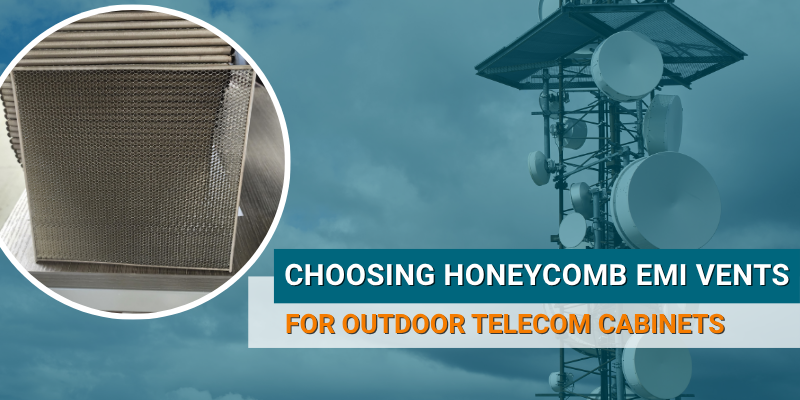
27 Aug Outdoor Telecom Cabinets: Choosing Honeycomb EMI Vents for Corrosion, Filtration, and Long-Term EMC
Outdoor telecom cabinets face several engineering requirements that can compete with one another. High-power electronics need sufficient airflow for cooling, yet every ventilation opening can also become a potential EMI leakage path.
Honeycomb EMI vents provide a practical solution by allowing air to move through the enclosure while maintaining electromagnetic shielding. Outdoor installations, however, introduce additional challenges such as moisture, dust, insects, salt contamination, corrosion, and extended maintenance intervals.
Selecting honeycomb EMI vents for outdoor telecom cabinets therefore requires looking beyond airflow and shielding specifications. Long-term performance depends on the complete operating environment, installation method, filtration strategy, and vent-to-enclosure interface.
Key Takeaways
- Honeycomb EMI vents can provide airflow while maintaining electromagnetic shielding in outdoor telecom cabinets, but long-term performance depends on the full installation environment, including moisture, dust, salt, temperature cycling, and maintenance intervals.
- Corrosion and galvanic compatibility are critical because vent cores, frames, fasteners, gaskets, coatings, and enclosure materials can interact in ways that degrade conductive contact and shielding performance over time.
- Filtration can protect electronics from dust, pollen, insects, and debris, but filters also increase pressure drop as they load with contaminants, so airflow, fan capacity, filter efficiency, and service intervals must be considered together.
- Moisture and RF leakage can occur around vent perimeters, fasteners, cut-outs, and poorly compressed gaskets, making the vent, gasket, cabinet opening, and mounting hardware an integrated sealing and shielding system.
- Proper honeycomb EMI vent installation can help preserve both EMC performance and environmental protection throughout the cabinet’s service life.
Quick Links
- Why Outdoor Telecom Cabinets Are a Different Venting Environment
- Define the Exposure Profile Before Selecting a Vent
- Corrosion and Galvanic Compatibility: The Hidden Requirement
- Filtration Strategy: Protection Versus Performance Drift
- Moisture Management and Ingress Points Around the Vent
- Installation Details That Protect EMC Performance Outdoors
- Outdoor Telecom Vent Selection Checklist
- Choosing Honeycomb EMI Vents for Long-Term Outdoor Performance
- Frequently Asked Questions
Why Outdoor Telecom Cabinets Are a Different Venting Environment
Integrating effective ventilation into an outdoor telecom cabinet is fundamentally different from specifying vents for a controlled indoor enclosure.
Outdoor equipment may operate for years while exposed to rain, snow, humidity, airborne dust, pollen, insects, industrial pollution, road salt, and repeated temperature cycling. These conditions can affect not only the vent itself, but also the frame, gasket, mounting hardware, and conductive surfaces connecting the vent to the enclosure.
Maintenance is another important consideration. Remote telecom installations may only be inspected periodically, meaning the vent, gasket, and filter system must continue to perform reliably between service visits.
At The ID Group, we work with telecom manufacturers on EMI shielding, ventilation, and environmental requirements. The operating environment is one of the first factors we consider when reviewing an outdoor application.
Define the Exposure Profile Before Selecting a Vent
Not every outdoor telecom cabinet faces the same conditions.
A cabinet installed in downtown Toronto may experience very different exposure from equipment mounted beside a coastal communications tower, an isolated highway, or a mining operation. Dust loading, humidity, airborne contaminants, and maintenance accessibility all influence the appropriate vent design.
Before specifying an outdoor telecom cabinet EMI vent, consider:
- Whether the installation is coastal or inland
- Exposure to road salt or industrial contaminants
- Humidity and moisture levels
- Airborne dust, pollen, or debris
- Seasonal temperature changes
- Expected maintenance intervals
- Required equipment service life
These factors influence material selection, plating, filtration, sealing, and maintenance planning. Successful vent specification begins with understanding the operating environment rather than selecting a catalogue part.
Corrosion and Galvanic Compatibility: The Hidden Requirement
Corrosion is one of the most important long-term considerations for outdoor EMI vent assemblies.
Galvanic corrosion can occur when dissimilar metals are in electrical contact while moisture or another electrolyte is present. One of the materials can then corrode preferentially, potentially degrading both mechanical integrity and conductive contact.
An outdoor telecom cabinet may combine several materials, including:
- Aluminum cabinet walls
- Honeycomb vent cores
- Vent frames
- Stainless steel or other fasteners
- Conductive shielding gaskets
- Plating systems
- Protective surface finishes
Each material may perform well individually but still create compatibility issues when combined.
Protective coatings introduce another consideration. While they can improve environmental resistance, non-conductive coatings at critical contact surfaces can interrupt the electrical path required for effective EMI shielding.
For this reason, engineers should evaluate the complete interface rather than asking only whether the vent itself is corrosion resistant.
Important considerations include the vent and frame materials, enclosure alloy and finish, fastener material, plating system, gasket compatibility, and expected environmental exposure.
In practice, we recommend starting with the installation environment and then working back toward the appropriate vent assembly. Coastal, roadside, and industrial locations can each require different approaches to material compatibility and corrosion protection.
Filtration Strategy: Protection Versus Performance Drift
Outdoor telecom equipment must also balance contamination control with cooling performance.
Dust, pollen, insects, and other airborne debris can enter an enclosure through ventilation openings. Where these contaminants present a risk to electronics, heat exchangers, or fan assemblies, filtration may be required alongside the honeycomb vent.
However, filters introduce their own engineering trade-off.
As a filter captures contaminants, airflow resistance increases. Pressure drop can rise, and cooling performance may gradually decline between maintenance intervals. The system therefore needs to be designed around more than the performance of a clean filter.
Engineers should evaluate:
- Expected dust loading
- Required airflow
- Allowable pressure drop
- Fan capability
- Filter efficiency
- Replacement intervals; and
- Accessibility for servicing
The ID Group provides custom air filter solutions for demanding applications. Where particulate contamination is expected, reticulated filter foam can provide a practical combination of airflow and contaminant capture.
The objective is to maintain predictable airflow throughout the maintenance interval, not simply achieve the best possible filtration when the filter is new.
Moisture Management and Ingress Points Around the Vent
Moisture management should consider the complete vent installation rather than only the honeycomb opening.
Potential ingress paths can include:
- Vent perimeter interfaces
- Fastener holes
- Cabinet cut-out edges
- Uneven mounting surfaces
- Poorly compressed gaskets
- Seams between the vent frame and enclosure wall
Small installation gaps can allow moisture to bypass the intended sealing system and can also contribute to corrosion around conductive interfaces.
Where EMC continuity is required, conductive shielding gaskets can help maintain electrical contact between the vent frame and enclosure while reducing RF leakage around the interface.
Environmental sealing may require different material properties. Foam or silicone gaskets can be appropriate where moisture and dust sealing are the primary requirements, but non-conductive materials should not be expected to provide electrical continuity.
Some outdoor designs may therefore require both conductive and environmental sealing functions. The appropriate approach depends on the EMC requirements, ingress-protection objectives, enclosure finish, and operating environment.
The most reliable designs treat the vent, gasket, cabinet cut-out and mounting hardware as one integrated system.
Installation Details That Protect EMC Performance Outdoors
Even a properly specified corrosion-resistant honeycomb EMI vent can underperform if it is poorly installed.
The first priority is maintaining a reliable conductive connection between the vent frame and enclosure. Paint, powder coating, anodizing, oxidation, or surface contamination can interrupt electrical continuity where conductive contact is required.
Equally important is achieving consistent mechanical loading. Uneven fastener spacing or tightening can create variations in gasket compression, increasing the possibility of both RF leakage and moisture ingress.
Before completing an installation, confirm that:
- Mounting surfaces are clean and properly prepared
- Coatings are removed only where conductive contact is required
- The intended conductive path is continuous around the vent
- The specified gasket is correctly positioned
- Fasteners provide even loading
- The perimeter is free of visible gaps
- Future inspection and maintenance remain practical
In our experience, the vent specification alone does not determine how the finished enclosure will perform. The mounting interface is part of the shielding system. Paying attention to installation details during assembly is significantly less expensive than diagnosing intermittent EMC failures after equipment has been deployed.
For additional information on frames, gasketing, corrosion resistance, filtration and installation options, see our guide to EMI honeycomb vent design features.
Outdoor Telecom Vent Selection Checklist
Before specifying honeycomb EMI vents for outdoor telecom cabinets, gather the information needed to evaluate the complete application.
Environment
- Cabinet location and exposure
- Coastal, inland, or industrial conditions
- Salt, dust, and airborne contaminants
- Temperature and humidity range
Thermal requirements
- Required airflow
- Fan configuration
- Allowable pressure drop
EMC requirements
- Frequency range of concern
- Required shielding performance
Mechanical requirements
- Cabinet material and finish
- Vent opening dimensions
- Mounting configuration
Maintenance requirements
- Filter replacement interval
- Accessibility
- Expected service life
- Inspection schedule
This information helps determine the appropriate vent material and plating, filtration approach, interface sealing, and installation requirements while balancing telecom cabinet airflow vs. EMI shielding.
Choosing Honeycomb EMI Vents for Long-Term Outdoor Performance
Selecting honeycomb EMI vents for outdoor telecom cabinets involves much more than balancing airflow and shielding performance.
Long-term EMC reliability also depends on corrosion resistance, material compatibility, filtration, moisture management, installation quality, and maintenance. Evaluating the complete vent assembly, including how it interfaces with the enclosure, can help preserve airflow and shielding performance throughout the life of the equipment.
At The ID Group, we work with engineers and manufacturers to identify EMI products and shielding solutions suited to their application and operating environment.
If you are selecting a honeycomb EMI vent for an outdoor telecom cabinet, we’d be happy to discuss the application with you. We can help evaluate the environmental, airflow, and shielding requirements and identify a practical approach for your enclosure.
Frequently Asked Questions
Should every outdoor telecom vent include a filter?
Not necessarily. Filtration requirements depend on the operating environment. Locations exposed to significant dust, pollen, insects, or other airborne contaminants may benefit from filtration, but pressure drop and maintenance requirements also need to be considered.
Can environmental gaskets replace conductive shielding gaskets?
Not when electrical continuity is required. Non-conductive foam and silicone gaskets can provide environmental sealing against moisture and dust, while conductive shielding gaskets are designed to maintain electrical contact. Some applications may require both functions.
How does corrosion affect honeycomb EMI vent performance?
Corrosion can degrade conductive contact between the vent frame, gasket, fasteners, and enclosure. Over time, this can reduce shielding continuity and affect the mechanical integrity of the vent assembly.
Why is the vent-to-enclosure interface important for EMC performance?
The vent must maintain reliable conductive contact with the enclosure. Poor bonding, coatings, uneven mounting surfaces, or insufficient gasket compression can create RF leakage paths around the vent perimeter.
Outdoor Telecom Cabinets: Choosing Honeycomb EMI Vents for Corrosion, Filtration, and Long-Term EMC
Choosing between vibration-damping pads and v...
Telecom Enclosure EMI Shielding for High-Frequency Systems: Seams, Vents, and Cable Entries
Choosing between vibration-damping pads and v...
Now Offering New Enclosure Shielding Gaskets
At The ID Group, we’re used to working clos...
The Advantages of Metal Etching for Custom Board Level EMI Shielding Solutions
Board level EMI shielding is imperative in en...

What is Board-Level EMI Shielding and Why Does It Matter for PCB Design
In the electronics industry, where devices ar...

Custom BeCu Board Level Shielding: Precision Protection for Critical Applications
Electronic systems are steadily becoming fast...

4 Differences Between Thermally and Electrically Conductive Elastomers
Conductive elastomers make a significant cont...

The Role of EMI Shielding in Medical Devices
Conductive elastomers make a significant cont...

Industry-Specific EMI RFI Shielding Applications
As the technology environment becomes increas...

5 Most Common Types of EMI Shielding Gaskets
EMI and RFI interferences are expressions of ...

4 Things to Consider When Choosing a Conductive Elastomer
Conductive elastomers make a significant cont...

The Role of Electrically Conductive Elastomers in EMI Shielding
From properties to composition, explore how e...

7 Benefits of EMI Shielding for Manufacturers
Electromagnetic interference (EMI) is a const...

Why Choose The ID Group for Your EMI RFI Shielding Needs
As owner of The ID Group, I'm proud to say th...

TechEtch 2500 Series: A New Standard in Shielding Effectiveness
In the world of EMI shielding solutions, the ...

Custom Die-Cut Foam Gaskets: Everything You Need to Know
Essential components in various industries, c...

Gasket Materials for Effective Sealing and Protection
Gaskets play a critical role in many of today...

9 Metals and Materials Used in EMI Shielding
Electromagnetic interference (EMI) is a nuisa...

EMI Shielding Fingerstock Gasket Mounting Options—An Overview
Electromagnetic interference (EMI) can affect...

Critical Performance Variables for EMI Honeycomb Vents
As technology evolves, so do the products req...


How Tech Etch Products Help with EMI RFI Shielding Issues
Electronic devices need robust protection fro...


What to Know About Beryllium Copper and EMI RFI Shielding
Today, most electronic devices are equipped w...

What is EMI RFI Shielding and How Does it Work?
To understand what is EMI RFI shielding, it i...