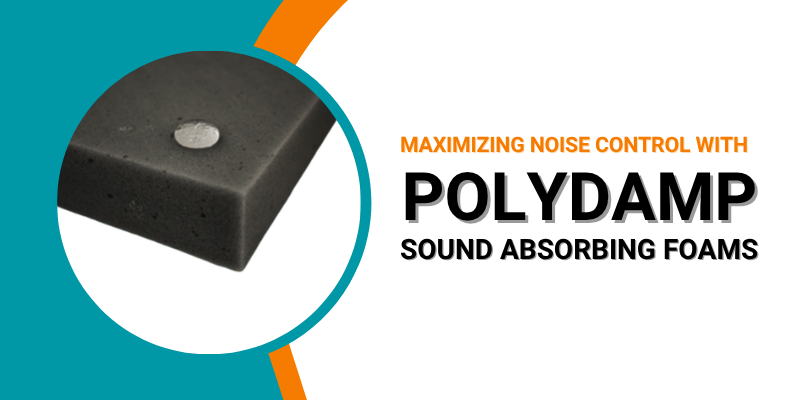
04 Nov Maximize Noise Control with POLYDAMP Sound-Absorbing Foams
Sound insulation in aircraft and many other human environments is key to comfort and operational equipment efficiency. Specialized sound-absorbing foams like POLYDAMP acoustic foams excel in environments where noise and vibration reduction, as well as thermal control, are essential. Here, I will explore how POLYDAMP materials function in aerospace, automotive, and industrial applications where lightweight noise control solutions support safety, durability, and productivity.
Key Takeaways
- POLYDAMP sound-absorbing foams are lightweight, open-cell materials that convert sound energy into heat, effectively reducing airborne noise and vibration while providing thermal insulation.
- These sound-absorbing foams combine acoustic performance with flexibility, enabling easy installation on curved or tight surfaces without adding significant weight.
- Durable formulations, including hydrophobic and melamine variants, resist moisture, chemicals, and wear, maintaining performance in harsh or humid environments.
- POLYDAMP acoustic foams are ideal for mid-to-high frequency sound absorption in applications such as aerospace fuselages, vehicle cabins, HVAC systems, and building interiors.
What Are Sound-Absorbing Foams?
Sound-absorbing foams are a diverse range of lightweight, engineered materials typically made from open-cell polyurethane or melamine, designed to deliver high-level soundproofing and vibration control. Their cellular architecture dissipates acoustic energy by converting sound waves into small amounts of heat, making them an effective solution for reducing airborne and equipment noise across a wide frequency range.
The key properties of acoustic foams, such as POLYDAMP, include excellent acoustic dissipation, combined with thermal insulation. Many formulations also provide fire resistance, meeting standards in aerospace and construction. Their durability allows them to withstand harsh operating environments over an extended functional life.
For example, POLYDAMP foams are widely used where low-mass noise and thermal management are required. In the automotive sector, they line panels, engine bays, and cabins. In aerospace, they are applied in fuselages, bulkheads, and interior panels to minimize cabin noise, adding low weight. HVAC systems exploit their noise-damping and thermal control capabilities. POLYDAMP foams enhance building acoustics and insulation in construction, while the marine industry employs them for quiet vessel operation.
Their versatility makes POLYDAMP sound-absorbing foams indispensable in modern noise-control engineering.
How do POLYDAMP Sound-Absorbing Foams Work?
POLYDAMP foams function primarily as sound absorbers rather than sound blockers. While sound blocking materials act as barriers by reflection or high-mass barrier, POLYDAMP foams reduce sound energy within a space by absorbing and dissipating the energy in micro rather than macro. Their structure allows sound waves to enter the material’s network of interconnected pores. As the sound waves travel through, friction and viscous resistance cause the acoustic energy to be converted to heat, dissipating the energy.
This principle of energy dissipation makes POLYDAMP acoustic foams particularly effective for mid-to-high frequency noise, such as speech, machinery hum, or HVAC airflow noise. These frequencies penetrate easily into the open-cell foam where they are effectively absorbed. While their performance at very low frequencies is more limited, since longer wavelength (λ) sound waves do not enter the cells. POLYDAMP foams can be combined with barrier materials or layered in composites for broader noise control.
This translates to significant improvement in acoustic comfort inside a cabin, fuselage, or building interior through sound insulation and vibration control. By targeting reverberation and airborne sound, POLYDAMP foams help create quieter, sound-deadened environments, making them an effective solution in industries where noise reduction is tied to safety, performance, and user comfort.
Benefits of Sound-Absorbing Foams for Noise Control
POLYDAMP acoustic insulation foams offer various advantages.
Superior Acoustic Performance
POLYDAMP foams are created with an open-cell structure that absorbs, randomly redirects, and dissipates sound energy. This helps reduce reverberation and echo in enclosed environments such as vehicle cabins, HVAC ducts, or building interiors. This results in improved acoustic clarity, speech intelligibility, and overall comfort, particularly for mid-to-high frequency noise. They also dampen vibrations, making them highly effective in environments with high noise levels.
Lightweight and Flexible
Unlike dense sound barriers, POLYDAMP foams are lightweight while still delivering excellent sound absorption. Flexible forms like Ultra-Flex and Ultra-Light allow installation on curved or complex surfaces (e.g., ducts, aircraft fuselage) with minimal weight penalty. Their softness and formability make them easy to cut, shape, and install in complex geometries or tight spaces. This ease of handling reduces installation labour and broadens their application into hard-to-form/install areas.
Durability
Engineered to withstand challenging conditions, POLYDAMP foams (particularly the hydrophobic melamine grade PHM) resist moisture absorption, chemical degradation, and physical wear. The hydrophobic versions retain acoustic and thermal performance even in wet or humid conditions. Mechanical properties such as compression set and tensile strength are preserved, ensuring long-lasting effectiveness in aerospace cabins, marine compartments, and industrial machinery housings.
Safety Features
Many formulations of POLYDAMP foams meet stringent fire safety standards, providing low flame spread, no dripping under flame exposure, and reduced risk of toxic emissions. This makes them suitable for safety-sensitive and highly regulated industries such as aerospace and automotive, where regulatory compliance and occupant protection are essential.
Cost Efficiency
By combining acoustic performance, durability, and safety, POLYDAMP foams deliver long service life with minimal maintenance needs. Their consistent reliability reduces the need for replacement through long equipment life, lowering the total cost of ownership and making them a cost-effective noise and thermal management solution.
POLYDAMP Acoustic Foams Availability
POLYDAMP is offered in a wide array of engineered acoustic foam types and variants, designed to meet different environmental, mechanical, and thermal requirements. Below is a summary of major product lines and their distinguishing features, which make them very compelling when there’s a need for strong sound absorption, weight/space efficiency, and environmental robustness.
POLYDAMP Acoustic Absorption Foams Comparison
| Product Type | Density (lb/ft³) | Temp Range (°F) | Thermal Conductivity | Flammability | Key Features |
|---|---|---|---|---|---|
| POLYDAMP® Acoustical Foam - Ether Type (PAF) | 1.8 | –45 to +212 (up to 250 intermittent) | N/A | UL94 HF-1 | Lightweight, flexible, resists heat, moisture & chemicals |
| POLYDAMP® Acoustical Foam - Ester Type (PAFS) | 2.0 | –45 to +212 (up to 250 intermittent) | N/A | UL94 HF-1 | Stronger & more durable than PAF; excellent resistance to heat, moisture & chemicals |
| POLYDAMP® Melamine Foam (PMF) | 0.56 | –300 to +356 (up to 492 intermittent) | 0.25 BTU-in/ft²-hr-°F at 68°F | UL94 V-0 | Very lightweight, excellent fire/smoke/toxicity performance; resilient to vibration and compression set |
| POLYDAMP® Hydrophobic Melamine Foam (PHM) | ~0.56 | –300 to +356 (up to 492 intermittent) | 0.25 BTU-in/ft²-hr-°F at 68°F | UL94 V-0 | Water resistant, floats in water; meets aircraft (FAA, BSS, etc.), HVAC, and transportation vehicle's flame, smoke, and toxicity standards |
| POLYDAMP® Melamine Foam Ultra-Flex (PMF-UF) | ~0.44 | Same as PMF | 0.25 BTU-in/ft²-hr-°F at 68°F | UL94 V-0 | More flexible, conforms to complex/curved surfaces. |
| POLYDAMP® Hydrophobic Melamine Ultra-Flex Foam (PHM-UF) | ~0.44 | Same as PMF | 0.25 BTU-in/ft²-hr-°F at 68°F | UL94 V-0 | Flexible and hydrophobic; exceptional resistance to heat, low flame propagation, and smoke. |
| POLYDAMP® Hydrophobic Melamine Foam Ultra-Lite (PHM-UL) | ~0.375 | Same as PMF | 0.25 BTU-in/ft²-hr-°F at 68°F | UL94 V-0 | Lightweight and water-resistant; aerospace compliant (FAR 25.856a); meets all FAA, BSS and AITM flame, smoke, and toxicity requirements for aircraft insulation |
Applications Across Industries
POLYDAMP foams are highly versatile acoustic solutions across multiple industries.
- In automotive and aerospace, they reduce cabin noise and damp vibrations in engine compartments, enhancing comfort and safety, delivering REACH compliance, among other standards.
- HVAC systems and appliances benefit from quieter operation, improving user experience.
- In construction and architecture, POLYDAMP is used for wall linings, acoustic panels, and office partitions to control reverberation.
- Marine and rail applications rely on its vibration and noise suppression for smoother, quieter rides.
Lightweight, flexible, and durable, POLYDAMP foams provide effective sound absorption across a broad spectrum of industrial and commercial settings, making them a practical and first-choice solution for noise control.
Conclusion
POLYDAMP sound-absorbing foams offer lightweight, durable, and highly effective solutions across most large-scale applications in automotive, aerospace, construction, marine, and more. Their versatility, fire resistance, low mass, flexibility, and acoustic performance make them essential for noise and vibration control, improving comfort, safety, and efficiency across industries.
The ID Group specializes in noise, vibration and temperature management. Contact us to learn more about our acoustic foam solutions that include a variety of POLYDAMP sound-absorbing foams. We’ll explain how we can customize them for your specific application.
Now Offering New Enclosure Shielding Gaskets
At The ID Group, we’re used to working clos...
The Advantages of Metal Etching for Custom Board Level EMI Shielding Solutions
Board level EMI shielding is imperative in en...

What is Board-Level EMI Shielding and Why Does It Matter for PCB Design
In the electronics industry, where devices ar...

Custom BeCu Board Level Shielding: Precision Protection for Critical Applications
Electronic systems are steadily becoming fast...

4 Differences Between Thermally and Electrically Conductive Elastomers
Conductive elastomers make a significant cont...

The Role of EMI Shielding in Medical Devices
Conductive elastomers make a significant cont...

Industry-Specific EMI RFI Shielding Applications
As the technology environment becomes increas...

5 Most Common Types of EMI Shielding Gaskets
EMI and RFI interferences are expressions of ...

4 Things to Consider When Choosing a Conductive Elastomer
Conductive elastomers make a significant cont...

The Role of Electrically Conductive Elastomers in EMI Shielding
From properties to composition, explore how e...

7 Benefits of EMI Shielding for Manufacturers
Electromagnetic interference (EMI) is a const...

Why Choose The ID Group for Your EMI RFI Shielding Needs
As owner of The ID Group, I'm proud to say th...

TechEtch 2500 Series: A New Standard in Shielding Effectiveness
In the world of EMI shielding solutions, the ...

Custom Die-Cut Foam Gaskets: Everything You Need to Know
Essential components in various industries, c...

Gasket Materials for Effective Sealing and Protection
Gaskets play a critical role in many of today...

9 Metals and Materials Used in EMI Shielding
Electromagnetic interference (EMI) is a nuisa...

EMI Shielding Fingerstock Gasket Mounting Options—An Overview
Electromagnetic interference (EMI) can affect...

Critical Performance Variables for EMI Honeycomb Vents
As technology evolves, so do the products req...


How Tech Etch Products Help with EMI RFI Shielding Issues
Electronic devices need robust protection fro...


What to Know About Beryllium Copper and EMI RFI Shielding
Today, most electronic devices are equipped w...

What is EMI RFI Shielding and How Does it Work?
To understand what is EMI RFI shielding, it i...